
She Quit
She Quit
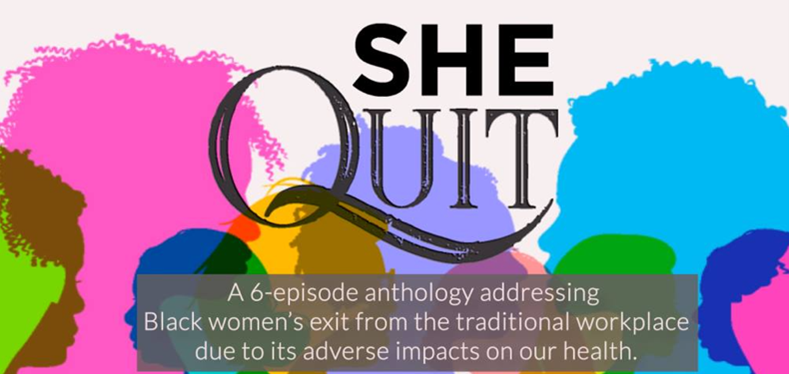
She Quit is a series dedicated to highlighting the unique skills Black women bring to the work force, unearthing the inequities Black women face in the workplace that force us to leave and facilitating conversations within workplaces that lead to significant workplace reform and safety for the women most impacted by the effects of COVID-19: Black women.
Project Overview
My name is Summer Nettles (Director and Executive Producer) and I am a Black woman who was raised by a single, Black woman. My mom was one of two Black nurses in her 1983 graduating class. Growing up, as my mom ascended into more and more powerful positions in the medical field, her successes were always tempered by stories of discriminatory treatment. I would marvel as my mom regaled me with tales of white male doctors who tuned her out and white female nurses who threw her under the bus. I’d be baffled at how anyone ignored my mom or missed her brilliance. My entire family relied on my mother’s medical advice and guidance.
Now, after 42 years of developing and nurturing relationships with hardworking, intelligent, innovative, fun Black women I’ve seen the stories my mom would tell me reflected over and over and over again in my life and the lives of my friends. But there’s one major difference: We’re quitting.
Since 2007, the number of firms owned by African-American women has grown by 164%.
“Black women are starting businesses at the fastest clip of any racial group, according to research by American Express” writes CNBC reporter Ellen Sheng in “This underfunded female demographic is launching the most start-ups in America, far from Silicon Valley.”

What are the current circumstances Black women face in the workplace?
November 2, 2019 was National Equal Pay Day, but according to Inc. Magazine Black women are not slated to see pay equity with our White male counterparts until the year 2119.
Despite being the highest educated population in the United States Black women are paid 61 cents for every dollar a White man makes. That wage gap could pay for 156 meals, two years of community college and two and half years of daycare says Harvard Business School. Studies show that when Black women are paid equally in a work place ALL PEOPLE in that workplace achieve elevated levels of equality. Black women are the rising tide that lifts all boats.
However, the inequities and racism Black women face in the workplace don’t just pose an economic threat, they cause a series of measurable mental and physical health issues that lead to: low birth weight infants, high infant mortality rates, death during childbirth, obesity, hypertension, diabetes and cancer.
She Quit opens with a montage of Black women talking about why they left the traditional work force to start their own businesses and ends with how the United States Government, regulatory agencies, supervisors and coworkers can support Black female workers. Additionally, She Quit will highlight the disparities between the support given to Black women entrepreneurs and their White male counterparts as well as how various entities can help Black women entrepreneurs.
Episode Overview
Episode 1: An overview highlighting the unique positive effects Black women have on the health, finances, communication and morale of their coworkers.
Episode 2: Physical Health
Episode 3: Financial Health
Episode 4: Mental Health
Episode 5: Relationship Impacts (Romantic and Familial)
Episode 6: Presents solutions government, regulatory, public and private industries can implement to level the playing field for Black women in hopes that the next generation of working Black women can prosper in White-led workplaces or receive the same level of entrepreneurial support.
Pitch Summary
Logline: A docuseries about Black women by a Black woman
She Quit is a six-episode docuseries about the exodus of Black women from the traditional workforce due to the health, financial and emotional trauma we are experiencing.
The goal is to alleviate Black women of the necessity to justify our value, explain and unpack the impact of racism and microaggressions on Black women to White supervisors and coworkers and help traditional workplaces recognize and address barriers to equitable treatment.
Target Audience: The target audience is women ages 25 to 54, government agencies, and corporations who wish to use the series as an educational module to spark conversations around equity in the workplace.
Genre: Docuseries, News, Infotainment
Similar Films and Series: The Thirteenth, Adam Ruins Everything, Freakonomics
Distribution Plan: Rocky Mountain PBS, National PBS, Corporate Retreats focused on Diversity, Equity and Inclusion (DEI), HR Departments, Film Festivals, Netflix
Outreach Partners: Black Chamber of Commerce, HR Association of America, Colorado City and County Managers Association, Colorado Black Women for Political Action, Urban Leadership Foundation of Colorado
Research Partners: Adams County Five Star Schools
Summer Nettles · Summer@GreaterPurposeMedia.com · 720.380.7668
Donation Form
She Quit Donation Form
"*" indicates required fields